
Originally posted on Investorintel.com
By : Alastair Neill
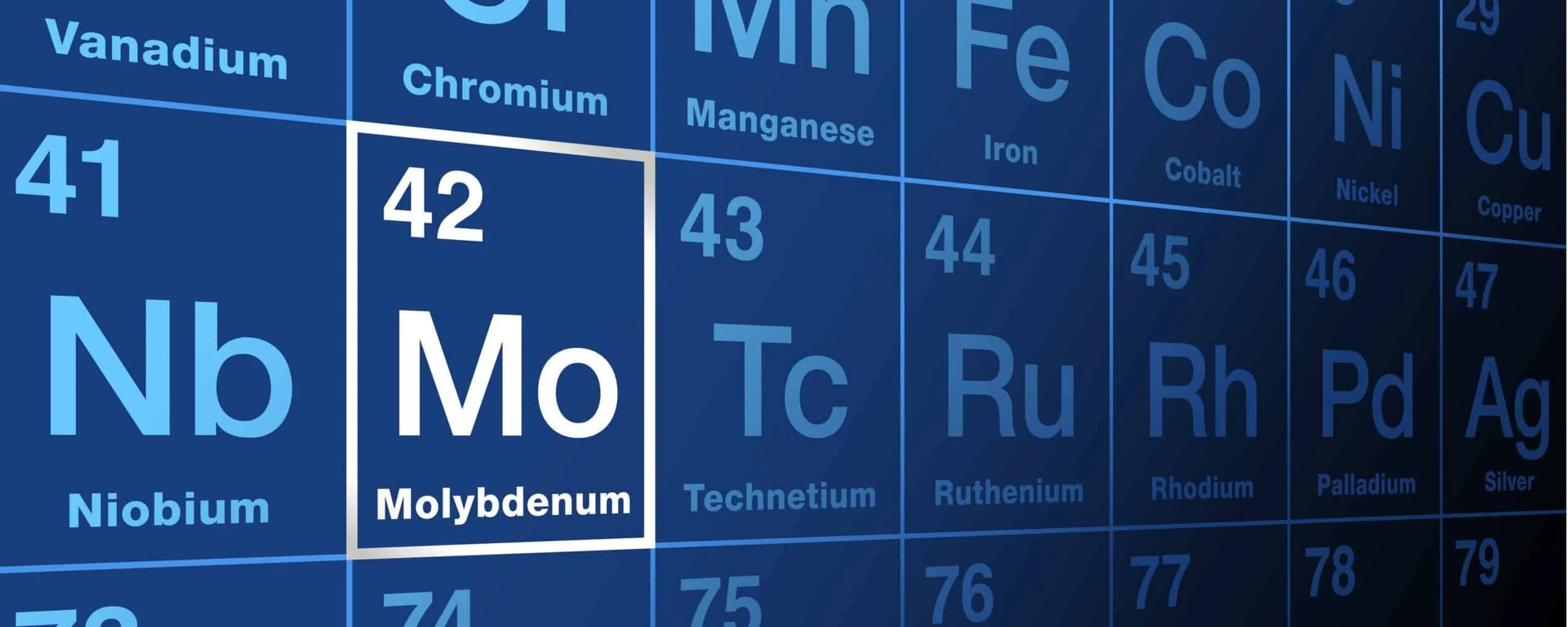
Element 42 on the periodic table is Molybdenum (Mo), commonly referred to in the industry as the easier to pronounce moly. Most of the world’s moly production comes as a byproduct from copper or tungsten mining. Most people know it as a lubricant. The main use of moly is in steel production as it gives weather and acid resistance in certain steel alloys, particularly stainless steel. This is an element largely overlooked as current production is in the range of 290,000-300,000 metric tonnes per year, which makes it a $10 billion annual business at its current pricing of $16/lb. Pricing earlier this year reached $20 per pound. Those are prices that have not been seen since 2008. Two years ago, the price was under $8 per pound.
According to the CPM Group, there are 76 mines globally that produce moly and 36 are inside China, with China producing over 40% of the world’s output. Between 70-80% of that output is from copper mines. In 2021 the world’s top 10 moly producing countries were:

Outside China, there are only two pure moly plays, and both of these are in Colorado and operated by Freeport-McMoRan (NYSE: FCX) subsidiary Climax Molybdenum. 90% of western-sourced moly comes from copper production. This means that the main driver for moly production is copper production, so output and pricing can be counterintuitive. An example of this was in 2020 when prices dropped 30% but production went up, while in 2021 prices climbed 96% but production went down.
According to a World Bank report on the impact of low carbon technologies (LCT) in 2018, 21 million tonnes of copper were produced compared to 0.3 million tonnes of moly, or about 1 tonne of moly per 7,000 tonnes of copper. Moly is used in wind turbines, with one megawatt of output requiring 130 kilograms of moly. A typical offshore turbine is 12MW, which requires 1.56 tonnes of molybdenum.
One of the issues facing the industry is Chile’s production. According to CPM, moly production in 2021 dropped 7.5% from 2020. The main drop was from Codelco, a state owned Chilean company, whose production declined 24%. A presentation by Codelco in 2019 indicated they needed new investment, otherwise production would fall by 74% by 2029. The Chilean government has asked Codelco to find $1 billion in annual savings and make a $8 billion cut in planned investments. This may delay investments. The Chilean government is talking about privatizing the mining industry and taking a royalty of up to 12%. These steps will likely give companies pause for thought on new investments. Based on this, the CPM Group is looking at a deficit position for moly over the next five years.
There is one potential new moly mine opportunity that is intriguing – Stuhini Exploration Ltd. (TSXV: STU) based in British Columbia. The CEO, David O’Brien, pulls a monthly salary of $2,000 which is different than a lot of junior mining companies. The share structure is very tight with 26.1 million shares issued and fully diluted at 28.3 million shares. Insiders hold 43% and Eric Sprott is a strategic investor.
Stuhini’s project is in Northwestern British Columbia and is called Ruby Creek. It has an option to earn 100% interest with a 1% NSR. There is a $22 million road built by a previous operator so there is access to the site. The mine was under construction by Adanac Molybdenum Corp. when it went bankrupt because of the 2008 financial crisis. This is a pure moly play, like the two mines in Colorado. A resource was released earlier this year with a measured and indicated resource of 433 million pounds. This gives an in situ value of $6 billion at current prices. Additionally, there are gold and silver indications on the property. Interestingly the market cap is $14 million while the previous operator had a market cap of $300 million.
It bears keeping an eye on this moly as low carbon technologies expand and what decisions Chile makes over the next few years. At present pricing, it can support new mines but there are few stand-alone opportunities. It is well worth keeping an eye on this market.